Context
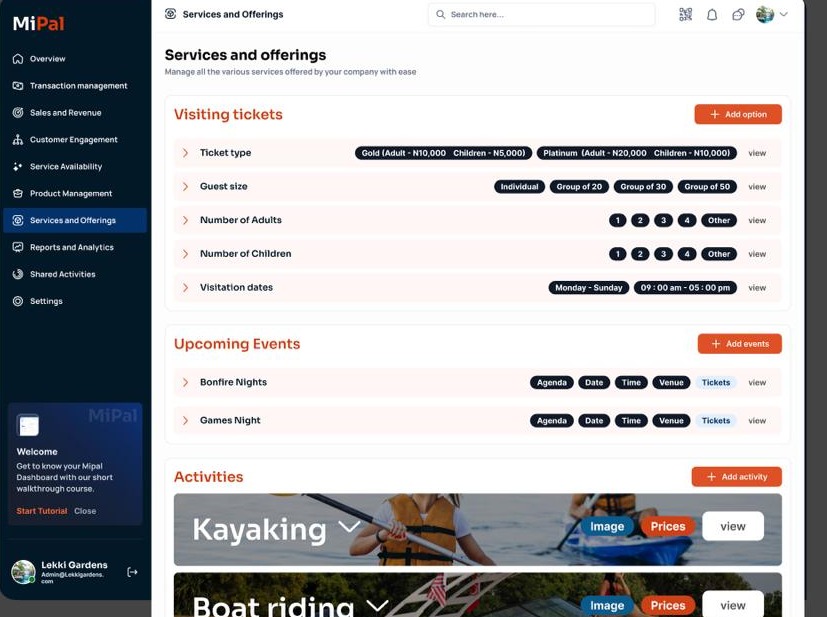
At Mi-Pal Technologies I owned end-to-end product discovery and delivery across two product lines — a B2B property platform and a hospitality marketplace connecting elite and local dining and leisure partners with guests. This case study covers the hospitality platform specifically: planned and executed from ideation to launch, working directly with engineering, design, and business teams — not solo.
Problem
A hospitality and leisure marketplace needs more than a booking list. Merchants — a kayaking operator, a boat-riding partner, a bonfire-night venue — needed a way to manage their own services, pricing tiers, and events without a product team hand-holding every listing change, and guests needed a coherent experience across genuinely different partner types that don't sell the same way.
Opportunity
Standardizing how wildly different merchant types get represented and managed in one admin surface was the real product problem — a generic "add a listing" form doesn't work when ticket types, guest-size tiers, and pricing structures vary this much by activity category.
Research
Sprint planning and backlog prioritization ran across engineering squads throughout the build, and structured customer discovery — 30+ interviews — surfaced specific onboarding friction points that were slowing merchant activation, not just guest-side usability issues.
Decision-Making
Translating stakeholder needs — merchants, guests, and the business side — into scoped, shippable releases meant deciding what belonged in the admin/merchant-management surface versus the guest-facing booking flow, and sequencing which merchant categories to onboard first.
Prioritization
The 30+ discovery interviews directly informed which onboarding friction to fix first. Those blockers were prioritized ahead of new feature requests because they were measurably suppressing merchant activation and adoption.
Execution
Managed the technical delivery, marketing, and merchant onboarding side by side — not just specifying requirements and handing off, but staying involved through launch to make sure the merchant-facing admin tooling (ticket types, guest-size tiers, event scheduling) actually got used correctly by real dining and leisure partners.
Collaboration
This was cross-functional team delivery, not solo work. Sprint planning and backlog prioritization ran across engineering squads, with design and business stakeholders both feeding into the same release cadence — directing that cadence, not just contributing to it, was the job.
Trade-offs
Fixing onboarding friction ahead of new merchant-facing features meant slower visible feature velocity in the short term, in exchange for a materially better activation number — the drop-off reduction below wouldn't have happened if new features had been prioritized over the onboarding fixes discovery surfaced.
Outcome
Sprint velocity increased 28% and recurring deployment delays were eliminated. Onboarding friction fixes reduced early drop-off by 35% and increased feature adoption by 22% — figures from Mi-Pal's actual product metrics, not portfolio estimates.
Reflection
The clearest lesson was that "two distinct product lines" doesn't mean two separate playbooks. The discipline of scoping releases against real discovery findings, not assumptions, was what let both the property platform and the hospitality platform ship on a genuinely disciplined Agile cadence.
Lessons Learned
Structured discovery interviews are only valuable if they change what gets built next — the 35% drop-off reduction came specifically from acting on what those 30+ interviews surfaced, not from running them as a box-ticking exercise.
Future Improvements
The honest gap is instrumented, ongoing analytics on merchant-side engagement post-onboarding — which categories of merchant activity retain best. The discovery work identified onboarding friction well, but longer-term merchant retention wasn't tracked with the same rigor in this role.
My Contribution
End-to-end product discovery and delivery ownership for the hospitality platform — sprint planning, backlog prioritization, the 30+ discovery interviews, and translating findings into scoped releases were mine, delivered by directing and collaborating with engineering, design, and business teams rather than working solo.